The DC Ultraman versus the Tsuburaya Ultraman
Published
Ultraman HistoryTsuburayaComicsMarvelCrime Syndicate
Type “Ultraman” into a comic shop search bar and you can get two very different answers. One is a towering silver and red hero from the stars who has protected Japan, and then the world, since 1966. The other is a cruel, caped bully from a backward Earth who exists to make Superman look good by comparison. They share a name and almost nothing else. Here is how two unrelated characters ended up with the same seven letters, and why fans on both sides should know the difference.
Two Ultramen, born two years apart
DC’s Ultraman came first, by a nose. He debuted in Justice League of America #29, cover-dated August 1964. Tsuburaya Productions’ Ultraman premiered on Japanese television on July 17, 1966. That gap is close enough to make people wonder whether one borrowed from the other, but the production histories point to separate roads that happened to arrive at the same word. Nothing we found in either company’s history connects the two.
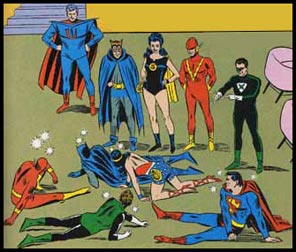
DC’s Ultraman: Superman in a funhouse mirror
By the early 1960s DC had two parallel worlds in play: Earth-One for its newer heroes and Earth-Two for its Golden Age originals. Writer Gardner Fox and artist Mike Sekowsky added a third. Earth-Three was a world where history ran in reverse. Columbus discovered Europe, and the Lincoln assassination happened the other way around. On that world there was no Justice League. There was the Crime Syndicate, villainous mirror images of DC’s biggest heroes: Ultraman for Superman, Owlman for Batman, Superwoman for Wonder Woman, Johnny Quick for the Flash, and Power Ring for Green Lantern.
Ultraman led the group. In the original version his Krypton never exploded, and kryptonite worked on him in the opposite way. Each exposure gave him a new power, and one of those exposures let him see across the barriers between universes. That is how the Syndicate learned that other Earths existed, crossed over, and picked a fight with the Justice League and the Justice Society. They lost, and the League sealed them away.
His look was built to be recognized in a single panel: Superman’s blue suit, red cape and red boots, worn by a man whose sneer told you everything. He was never meant to be a design of his own. He was a parody, a warped copy you were supposed to compare to the real thing.
That first Ultraman met his end in Crisis on Infinite Earths #1, cover-dated April 1985. A wave of antimatter swept across Earth-Three. The Syndicate, in a rare moment of something like heroism, tried to hold it back and failed. Ultraman went down swinging, declaring that he would fight to the very end, and Earth-Three was erased.
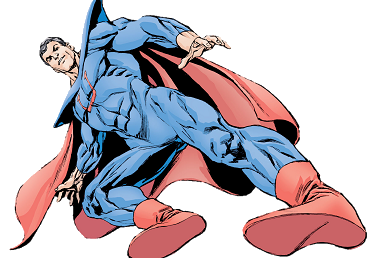
The antimatter astronaut
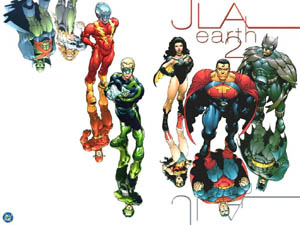
DC brought the idea back several times, and the best known revival is Grant Morrison and Frank Quitely’s 2000 graphic novel JLA: Earth 2. With the old multiverse gone, Morrison moved the Crime Syndicate of America to an antimatter universe, a mirror world where evil is the natural order and good is doomed to lose.
This Ultraman was not Kryptonian at all. He was Lieutenant Clark Kent, a human astronaut from the antimatter Earth whose ship came apart in hyperspace. An unknown alien race rebuilt him and, in doing so, gave him powers like Superman’s while twisting his mind. His strength depended on a substance called anti-kryptonite, and the longer and farther he was away from it, the weaker he became. Morrison also gave him a miserable home life, unhappily married to Superwoman while she carried on an affair with Owlman. The book was later adapted into the 2010 animated film Justice League: Crisis on Two Earths.
Kal-Il and Forever Evil
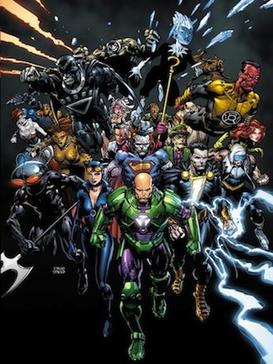
When DC relaunched its line as the New 52, Geoff Johns rebuilt Earth-3 and its Ultraman once more. This version is Kal-Il, son of Jor-Il, from a Krypton whose people were selfish and cruel. Sent to Earth-3 as a child, he forced a pair of addicts named Johnny and Martha Kent to take him in, then killed them once he no longer needed them. He believed only the strong deserved to live. When the being that destroyed his Krypton also ravaged Earth-3, he led the Crime Syndicate to DC’s main Earth to take it over.
That invasion drove Forever Evil, the 2013 to 2014 crossover written by Johns with art by David Finch. With the Justice Leagues apparently dead, the Syndicate ruled through fear, and it fell to Lex Luthor and a band of villains to fight back. It remains the most prominent stage the DC Ultraman has ever had.
He has kept turning up since, including a 2025 movie appearance. In James Gunn’s Superman, Ultraman is a masked, silent clone of Superman created by Lex Luthor and played by David Corenswet, who also plays the hero.
Tsuburaya’s Ultraman: a giant from the Land of Light
The Japanese Ultraman grew out of a very different place: a special effects studio. Eiji Tsuburaya, the effects master behind the original Godzilla, founded Tsuburaya Productions, and its first big series was Ultra Q in 1966, a black and white show about strange phenomena and giant monsters. Its success led broadcaster TBS to ask for a follow-up in color.
Tsuburaya and writer Tetsuo Kinjo built the new show around a team that investigates and fights monsters. Early drafts called the hero Bemular, then Redman, after his color scheme. By March 1966 the title was Ultraman. The name Bemular was handed down to the very first monster he fights.
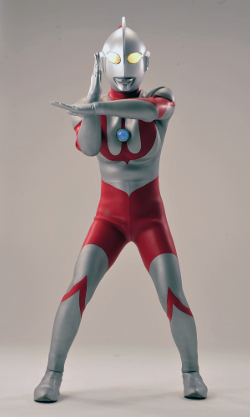
The hero’s look belongs to production designer Tohl Narita. Tsuburaya found the early drafts “too alien and sinister,” so Narita kept going. He drew on the Greek idea of cosmos, order and harmony, as a deliberate contrast with the chaos of his Ultra Q monsters, and took cues from classical Greek art, ancient Egypt and the Renaissance. The silver skin stood for the steel of an interstellar rocket, and the red lines for the surface of Mars. Narita’s assistant, Akira Sasaki, sculpted the face in clay. Late in production the team added the Color Timer, the chest light that warns when Ultraman’s time on Earth is running out, because they felt he seemed too invincible without it.
Creator credits for the character usually name Eiji Tsuburaya and Tetsuo Kinjo, with Kazuho Mitsuta, a director who worked on the original series and later produced for the studio, and Akira Sasaki listed alongside them. Narita is credited as the designer.
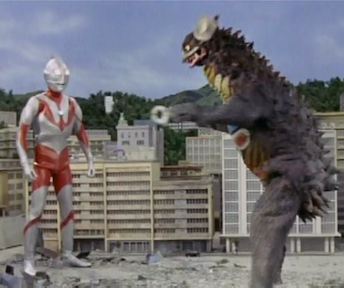
In the story, Ultraman comes from Nebula M78, the Land of Light. While chasing the monster Bemular to Earth, he collides with the aircraft of Shin Hayata, a member of the Science Patrol, and Hayata is killed. Out of guilt, Ultraman merges with him and gives him the Beta Capsule. From then on, whenever a monster or alien threatens Earth, Hayata can become a 40 meter tall giant. The series ran 39 episodes, from July 17, 1966, to April 9, 1967, and launched a family of heroes that is still growing.
Side by side
Put the two next to each other and the differences are bigger than the similarities.
DC’s Ultraman wears a costume. It is cloth, a cape, a color scheme borrowed on purpose from Superman. He is human sized, and he only works as a character because you already know who he is copying.
Tsuburaya’s Ultraman wears nothing. The silver and red is his body. There is no cape, no emblem and no secret identity costume, just a smooth, calm face, glowing eyes and the Color Timer in his chest. He is a giant who fights monsters as tall as he is, and his design was meant to stand for order and harmony.
Both are aliens with Earth names, and both are tied to a man called Clark or Shin who lives a double life. The core idea is the opposite, though. One is a hero who chose to save a world that is not his. The other is what a Superman looks like when he decides a world belongs to him.
The name and the real Marvel connection
So why do people mix them up? Partly the name, and partly the publisher. Many fans file all American superhero comics under “Marvel,” and in a way they are half right, because there is a Marvel Ultraman, and it is the Tsuburaya one.
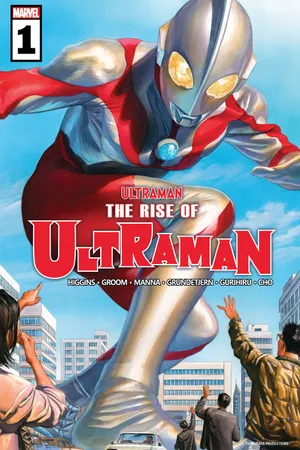
Marvel Comics announced a partnership with Tsuburaya Productions in 2019. The first result, The Rise of Ultraman by Kyle Higgins and Mat Groom with art by Francesco Manna, launched in September 2020 and retold the origin of Shin Hayata and the United Science Patrol for a new audience. It was followed by The Trials of Ultraman in 2021 and Ultraman: The Mystery of Ultraseven in 2022. In 2024 came the crossover fans had been waiting for, Ultraman x the Avengers, a four issue series by the same creative team in which Ultraman meets Earth’s Mightiest Heroes and faces Galactus.
There are smaller nods too. Marvel’s Exiles had a story in which the shapeshifter Morph takes on Ultraman’s look, and director Peyton Reed has said Ultraman was among the Japanese heroes the team looked at when designing Ant-Man’s movie suit.
On the DC side, there has never been a meeting between the two. Their Ultraman and Tsuburaya’s live in separate worlds, owned by separate companies, and that is unlikely to change.
Which Ultraman is ours
If you came to this site looking for Ultraman, you found the one from the Land of Light. The Ultraman Card Game brings Tsuburaya’s heroes and kaiju to the table, from the original giant who merged with Shin Hayata to the generations of Ultras who followed him. The next time someone at your game night asks whether Ultraman is the evil Superman, you will have a good story to tell them. Then you can deal them in.
Sources
- Wikipedia, “Ultraman (DC Comics)”
- Wikipedia, “Crime Syndicate of America”
- Wikipedia, “JLA: Earth 2”
- Wikipedia, “Forever Evil”
- DC, Forever Evil collected edition page
- DC Comics News, “The Villains Are Here: Geoff Johns & David Finch Talk Forever Evil” (Sept. 4, 2013)
- The Annotated Crisis #1 (Crisis on Infinite Earths #1, April 1985)
- Crisis on Earth-Prime, “Crisis on Infinite Earths #1: The Summoning!”
- Entertainment Weekly, “That Ultraman Superman twist and the comic book history behind it” (July 14, 2025)
- Wikipedia, “Ultraman (1966 TV series)”
- Wikipedia, “Ultraman (character)”
- The Japan Times, “Ultraman creator Kazuho Mitsuta” (May 13, 2008)
- Ultra Database (Fandom), “Kazuho Mitsuta”
- Marvel, The Rise of Ultraman (2020) #1
- Marvel, “Ultraman Returns in ‘Ultraman: The Mystery of Ultraseven’” (May 17, 2022)
- Marvel, “‘Ultraman X Avengers’ Brings Together the Greatest Hero of Japan & Earth’s Mightiest Heroes” (May 22, 2024)
- ComicBook.com, “Ultraman X Avengers: Kyle Higgins and Mat Groom Break Down the Anticipated Team Up” (July 11, 2024)
- Tsuburaya Fields Entertainment International, Ultraman x Avengers
- Den of Geek, “The Surprising Tokusatsu Influences of Ant-Man”